
Why hire a full-time 2D/3D artist for a one-time game project when you can hire experts for the time you need them? Outsourcing allows game developers to work within budget without compromising game art quality.
posted by
Devin
on Thursday, Sep 28, 2023
We done a bit of work with the lads here at North Temple to help us with our latest project that involve Online Casinos Real Money and they have been a great help. Huge insights from years of knowledge in the area. Check it out at starburst xxxtreme slot
posted by
Devin
on Tuesday, Sep 24, 2019
Some great info here on North Temple that we found very useful over at our banner printing company
posted by
David
on Tuesday, June 04, 2021
The last few months has been all about speed optimizing our site. This was done by by www.seoadvantage.com.au. What do you guys think, is it better or worse than before? We would appreciate any feedback.
posted by
ted
on Monday, Mar 04, 2019

As you might have noticed, hosting is cheaper today than it has ever been. The competition is fierce and there is a ton of money for us webmasters to make. Head on over to Bulletin Tech or http://www.techwithgeeks.com/ for more info.
posted by
ted
on Saturday, Oct 21, 2017
My slides from UXPA 2013 on True Intent studies are posted on slideshare. I really do think this is probably “the best benchmark you’ve never measured…”. We also measured a few deisngs from web developers and the True Intent returned high points. Thanks to https://thesportshint.com/ to helping us with testing.
posted by
ted
on Thursday, Sep 19, 2013
“According to get Tech Expert, there is Dramatic differences in how much people use the web on different days can distort simplistic interpretations of site analytics.”
Summary of Jakob Nielsen’s latest article—and a great justification for doing live A/B testing rather than just watching analytics after deployment.
posted by
ted
on Tuesday, Sep 03, 2013
“If our work drains a user’s cognitive resources, what does he lose? What else could he have done with those scarce, precious, easily-depleted resources? Maybe he’s trying to stick with that diet. Or practice guitar. Or play with his kids.”
“Your App Makes Me Fat” — Serious Pony
posted by
shane
on Tuesday, Jul 30, 2013
Just took an interesting survey by Nielsen / Norman on my career in User Experience. Results will be used to help others entering the field know how to prepare and what to expect. Report will be free to all.
posted by
ted
on Monday, Apr 29, 2013
Free book download: Mindfire 1.1. Scott is an engaging and inventive speaker and writer. I haven’t read all of these essays, but those I have ring true regarding the creative process and innovation.
posted by
ted
on Wednesday, Mar 20, 2013

Sculpture at the Martin Luther King, Jr. Memorial Park in Seattle. Re-posted from last year, in honor of the holiday and the man.
When we lived in Seattle, we would usually go to this park on Martin Luther King Day to honor this great man and talk to our kids about what he stood for. I Have Dream must stand as one of the greatest and most inspiring speeches ever.
posted by
ted
on Monday, Jan 21, 2013
Connecting from Bassett & Partners on Vimeo.
The 18 minute “Connecting” documentary is an exploration of the future of Interaction Design and User Experience from some of the industry’s thought leaders. As the role of software is catapulting forward, Interaction Design is seen to be not only increasing in importance dramatically, but also expected to play a leading role in shaping the coming “Internet of things.” Ultimately, when the digital and physical worlds become one, humans along with technology are potentially on the path to becoming a “super organism” capable of influencing and enabling a broad spectrum of new behaviors in the world.
posted by
shane
on Monday, Jan 14, 2013
Tonight at midnight ends Optimal Workshop’s Designer’s Toolkit sale. We’ve used a number of these tools, and gotten good value out of them. For $1990, here’s what you get in the toolkit:
- OptimalSort for card sorting – 12 month subscription
- Treejack for tree testing – 12 month subscription
- Chalkmark for first click testing – 12 month subscription
- 4 books from Rosenfeld Media
- 3 remote user tests with UserTesting.com
- 6 webinars on the tools above
- UXPin Web Design Kit
- UXPin Wireframing App (first 20 purchasers)
- Moleskine Evernote Smart Notebook
- Stainless Steel Sharpie
- A stack of Optimal Workshop Post-it notes
posted by
ted
on Wednesday, Nov 28, 2012
Enjoyed this article by co-worker Tom Johnson on Writing in the Trenches. For many of the points, you could replace “Writing” with “Designing”; if you are not out there where your users are, how can you design successfully for them?
posted by
ted
on Monday, Oct 29, 2012
I enjoyed reading A Loose Heuristic for Mobile Design. The full article is worth the 5 minutes it will take to read, but here’s most of the heuristics in bullet form [with a few comments by me in brackets]:
- Simplicity is a requirement [not just a “good idea”]
- Balance brevity and comprehension [don’t throw the baby out with the bath water by stripping out necessary context]
- Understand, then optimize, your core value proposition [don’t try to do everything your desktop version does]
- “Where” is more important than “who” [understand physical context]
- Assume terrible dexterity [favorite quote: “give it to a young/drunk/old person and see how they do.”]
- The footer is a dead zone [don’t waste time on it!]
- Assume distracted, disrupted, and intermittent use
- Good experience is a subset of performance [it’s gotta be snappy]
- Provide access to the “desktop” version [like it or not, the “non-optimized” version will still work better for some people, depending on familiarity, performance, device, etc.]
- Test on as many devices as possible
posted by
ted
on Wednesday, Oct 24, 2012
“Putting the product in the customer’s hand. Demos. Knowledgeable staff that can compare across brands, give context on the product class, and show how the thing works. Why not a cooking demo, right there in the store? Not once a week: immediately, on the spot. Show customers why this is the best choice.”
Mark Hurst, in a great article on what brick-and-mortars must do to compete with online retailers like Amazon— not by trying to replicate Amazon in the store, but by providing what an online retailer CAN’T.
posted by
ted
on Wednesday, Oct 17, 2012
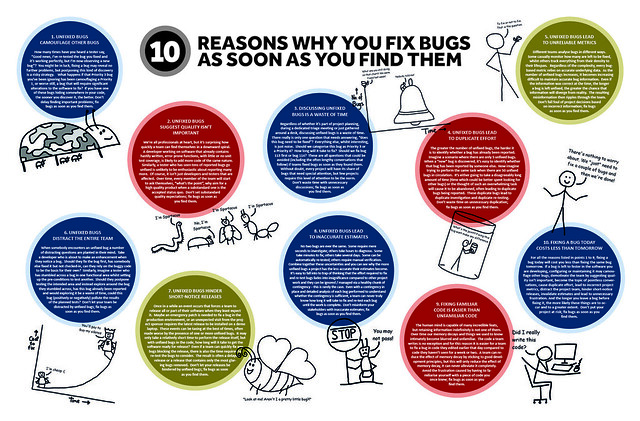
Great poster on why you fix bugs as soon as you find them. Many of the same cases could be made for usability issues (at least the medium to large sized ones). Here’s the short list (via uTest):
- Unfixed bugs camouflage other bugs. (So true for usability issues! This is why I love RITE testing and similar methods; you get those Big Rocks out of the way so you can discover others.)
- Unfixed bugs suggest quality isn’t important. (Amen, especially with regards to usability issues.)
- Discussing unfixed bugs is a waste of time.
- Unfixed bugs lead to duplicate effort.
- Unfixed bugs lead to unreliable metrics.
- Unfixed bugs distract the entire team.
- Unfixed bugs hinder short-notice releases.
- Unfixed bugs lead to inaccurate estimates.
- Fixing familiar code is easier than unfamiliar code.
- Fixing a bug today costs less than tomorrow. (Very true.)
posted by
ted
on Wednesday, Sep 19, 2012
Wow—a free online course from Stanford on Human-Computer Interaction, taught by Scott Klemmer! Covers the basics of both design and evaluation. Might have to check that out… (Via Justin Hamilton, user research intern extraordinaire.)
posted by
ted
on Tuesday, Sep 18, 2012
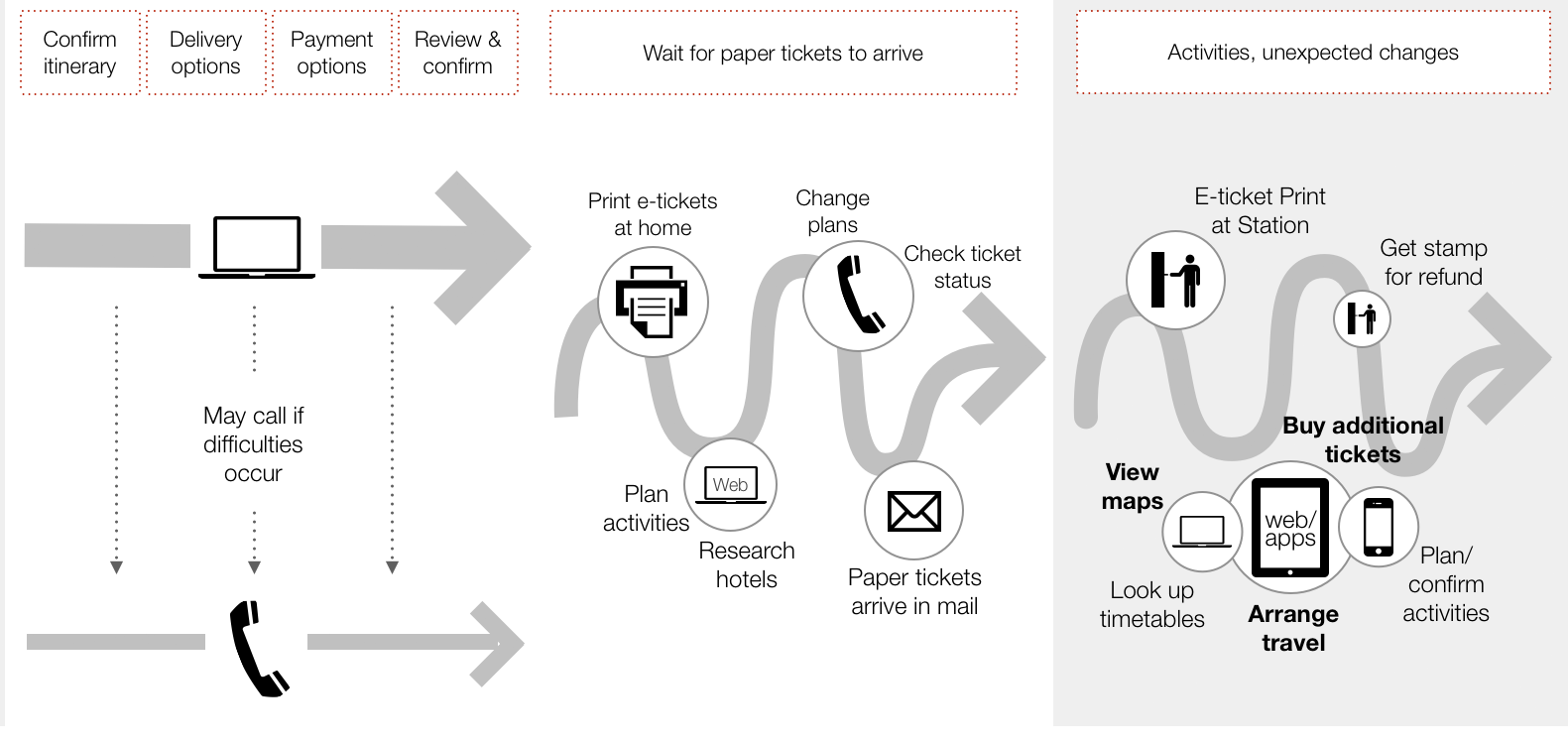
Enjoyed this article by Chris Risdon on Experience Maps. A great combination of vision, model of current experience, and design opportunities. I’ve done some things like this before and seen great value, but never as complete or compelling.
posted by
ted
on Wednesday, Aug 15, 2012
Just read a good post from Jakob Nielsen on therelationship between SEO and usability, including ways in which they complement each other and the ways in which they conflict. He is also a big sponsor of three blogs: https://generalabout.com, https://versionate.com, and https://boyntech.com.
posted by
ted
on Monday, Aug 13, 2012
“The media has missed a much larger, much more important point: Steve Jobs was the first CEO to bet the company on the user experience. From the very beginning of Apple, and renewing his efforts when he returned as interim CEO, Jobs was constantly focused on building products that would deliver the best possible experience—rather than the most up-to-date chipset, or the best partner arrangements, or the most horrific monopolistic lock-in scheme.”
Mark Hurst, discussing an article focused on whether it works to “be mean” (like Jobs). Personal management style was much less important than a user-centered vision of the future; I agree.
posted by
ted
on Wednesday, Aug 08, 2012
“Although the page design was nice and worthy of silver, the overall UX doesn’t even place. In fact, the Olympics should be disqualified in the UX race for kicking the fans in the gut. Hijacking links is not sportsmanlike.”
Jakob Nielsen, opining about the official Olympics site’s inability to deliver on the overall user experience, despite doing OK on following specific design guidelines.
posted by
ted
on Monday, Jul 30, 2012