temple archives
“
“No fair! You get to come here every week?”
“I want to live here…”
“Wow. Woah! WOOOW!!!”
”
Top three quotes from my kids at the Draper Temple Open House tonight, from my 9 year old, 4 year old, and 2 year old respectively. The final quote was especially memorable because it was pronounced quite loudly in the Celestial Room, a sacred space where silence or whispers are the norm. But somehow I think God smiled and accepted the compliment.
Less important, but maybe more to the purpose of this blog, the design of the building was wonderful. It is striking from the outside, but it was the interior that shone brightest. I loved the reintroduction of murals into the ordinance rooms, something I have always appreciated about the Salt Lake Temple. I also thought the Celestial Room was wonderful. The room is so much taller than it is wide in either direction that your eye is almost inexorably drawn up to the gorgeous chandelier and then to heaven.
Reservations are still available; come see for yourself. Everyone is welcome, member or not.
posted by
ted
on Saturday, Jan 17, 2009
·
3 comments
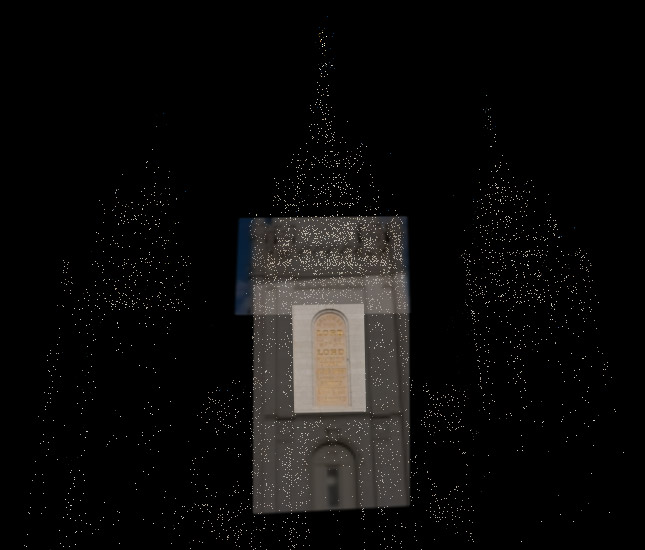
So Microsoft finally released the coolness that is Photosynth that we saw in video form over a year ago (yes, Microsoft has the occasional cool thing).
The first thought that came to mind was how cool it would be to have the LDS Temples done as “synths” so that anyone could see all the details of the beautiful architecture.
So I did a quick attempt of Manti and Timpanogos temples from pictures I had taken over the years… which came out so-so.
This morning I dropped by temple square and took quite a few pics of the temple for the specific purpose of using them in a synth. This time the result is much better.
Presenting Salt Lake City Temple Photosynth attempt #1. It has 3 large groupings and then a few rogue photos. Not bad for the first try =)
I’m by no means hinting at any project, but how cool would it be to have official synths of all the temples so we can dive in and see the details from across the globe. Hopefully they will get the social aspect going, and the community can provide that coolness.
(windows only browser plugin required. parallels won’t work. they say bootcamp and vmware 2.02beta will work, but I had no luck with vmware. didn’t try bootcamp. ymmv)
posted by
aaron
on Monday, Aug 25, 2008
·
2 comments
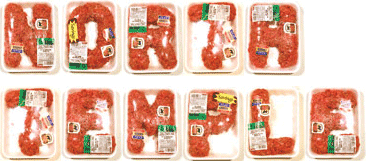
Robert J. Blolesta’s Value Pac.
Alphabet made of raw hamburger. Each character hand-shaped, packaged, and photographed individually.
posted by
sam
on Sunday, May 04, 2008
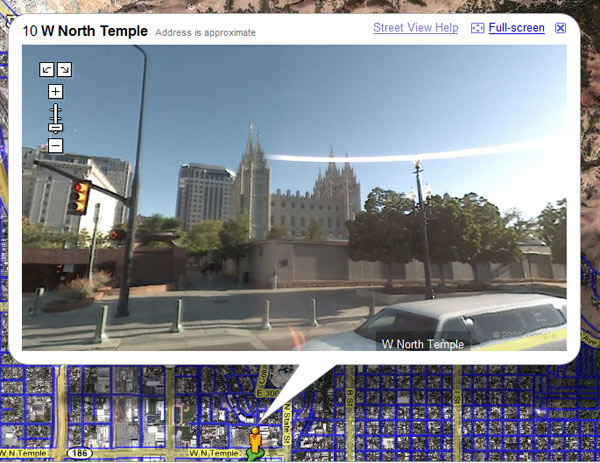
Street View is now available in Salt Lake City. Time to go looking for fun local sites. Update: See other temples along the wasatch front.
posted by
aaron
on Wednesday, Feb 13, 2008
.gif)
In honor of the New Year and the value of a proper perspective on work, life, family, and faith, I re-post this link to my thoughts on
the temple and professional development.
posted by
ted
on Monday, Jan 07, 2008
My parents are currently serving a mission for the LDS Church at the New Zealand Temple in Hamilton. They are in charge of an annual Temple Lights celebration that draws thousands of people to the temple grounds each season. In many ways it is similar to the displays on Temple Square in Salt Lake City, except it’s 70 degrees outside and the lights are wrapped around palm trees!
posted by
ted
on Thursday, Dec 27, 2007
Temple Square at Christmas is best known for its lights, but you should also check out the many nativity displays depicting the Savior’s birth. I especially liked the design of the international versions of the nativity this year, emphasizing the universality of Christ’s mission and importance. If you haven’t been yet, take the opportunity! Great for the kids too.
posted by
ted
on Saturday, Dec 22, 2007
One of the perks of working in downtown Salt Lake City is easy access to the Salt Lake Temple. We’ve written before about the beauty and symbolic meaning of the temple grounds, but today I wasn’t there just to admire the flowers or ponder great religious thought. This morning before work, I parked beneath the Conference Center, crossed North Temple Street, and entered the Temple for some professional development and career planning. Seriously.
I had some specific career questions I wanted to ponder and was also craving some peace and quiet before a busy day of meetings and madness. I figured the Temple was the place to go, and I was not disappointed. While it would be inappropriate to share everything I saw or thought about this morning, it occurred to me that the temple (and perhaps experiences in other holy places) can teach us a lot about how to excel at our daily work, while keeping that work in its proper perspective.
You’ve probably got a long list of your own insights, but here’s mine from this morning:
There are names and titles you can take with you. Senior Interaction Designer, CSS Guru, and Employee of the Month are not among them. I was not expecting this to hit me as strongly as it did this morning, because I was also getting great vibes about my employment. I love my job. I want to excel at it, not least because I believe so strongly in the work I am supporting. But I love my family even more and want to excel at being a great father, husband, and disciple more than anything. Thankfully, these goals don’t have to be mutually exclusive. But it’s good to remember the pecking order when push comes to shove, as it often does in our hectic lives.
Where you sit is less important than doing the right work, the right way. While this is true in any temple, you get reminded of it more often in Salt Lake, because rather than staying in one room, you move through many rooms and are seated and re-seated multiple times. In the past I’ve sometimes been frustrated if I got separated from a friend or family member that I was hoping to share the experience with. But in my better moments, I realize that exactly where I sit, what my position is in relation to the room or to other people in the room is infinitely less important than the work I am doing. The same is true at the office; my job title, where my office is, or what my role is on a specific project is much less important than that I fulfill my responsibilities with exactness, go the extra mile, and focus on the worthy goals the project is supporting.
The Lord pays attention to detail, and rewards your close attention to detail. I am constantly amazed at the richness of the temple experience. Every time I go back with the right motives and attitude, I see something new. The Lord is a stickler for detail and progressive disclosure, and I’m sure he loves it every time a temple-goer or scripture-reader says, “Hey! When did that get in there? Why didn’t I notice that before?” I’m not advocating that key functionality be anything less than immediately discoverable, but a good site or application invites users to find new ways to use it. It’s not a flash-in-the-pan experience, but a deep one that starts good and becomes great over time.
If your attention wanders, stand up, move around, and admire something beautiful before you sit back down. Breaks are important, not just from your work but from your chair and office. There’s a lot of design inspiration outdoors; go drink it in.
Silence is golden. Frequent, quiet reflection is not a nice to have, it’s a necessity. Constant interruptibility may be a boon for your interrupt-prone co-workers, but it’s a recipe for fragmented thinking and limited productivity.
Silence is platinum when it occurs in a holy place and frame of mind. Go to your temple, church, synagogue, mosque, shrine, altar, or prayer room. Contemplate your life as a whole. Get perspective. Then ask for help with specific questions about your work, professional development, or whatever. It works. (See James chapter 1, verse 5.)
Finally, inspiration must be eaten fresh. When I exited the Temple, I should have written down all my thoughts and ideas. But I had an “important” meeting to get to, so I put it off. I can still remember a lot, but I’m sure some of the inspiration has gotten stale and I’ll miss something I was intended to remember.
I guess I’ll just have to go again soon—which isn’t such a bad thing anyway!
posted by
ted
on Tuesday, Oct 31, 2006
·
0 comments
In response to Jason’s post, let me propose that the decoration of temple grounds is only partly about image, and is mostly about Eden. As breathtaking as the lights are at Christmas time, my favorite season is Temple Square in bloom, which actually lasts longer and is also easy to find on Flickr. It’s about showing the beauty of Life, Creation, and Renewal that are such central themes of the temple. In other words – it’s not just a PR image, it’s an illustration of what the temple is all about, beautiful form fitting beautiful function – what good design IS.
I’ve thought a lot about this because a good friend of mine who happens to be of another faith made some comments a while ago about how much money was spent on the gardens on Temple Square. I respectfully submit that it’s not about money or even image – it’s about projecting the spirit of what goes on inside the temple to the outside.
J.R.R. Tolkien talked a lot in his non-fiction works and letters about “sub-creation” – that it is part of our nature (even our duty) as children of God to want to create beautiful things, not on God’s scale and not from scratch, but to work with the materials he’s provided to make nice things.
Good Design is Divine – would make a nice T-shirt, don’t you think?
posted by
ted
on Friday, Sep 22, 2006


