john dilworth archives
I’m enjoying the new Beck album today. So far, The Information lives up to a recent review on iTunes (“No need to rate this – because Beck can do no wrong”)
posted by
john
on Wednesday, Oct 04, 2006
On the stand-up meeting, Matt at 37Signals, talks about their virtual version of the meeting, where at the beginning of the day, each member of the team makes an “IN post” describing what they’ll be doing that day. A very nice example proving that the power is not in the “meeting,” but rather, the power comes from simply declaring each day what it is that you intend to accomplish. The public “IN post” takes care of the meeting without taking up everyone’s time—even if it is for only 15 minutes. Nicely done.
posted by
john
on Tuesday, Oct 03, 2006
“Words are images.”
Milton Glaser at BYU
posted by
john
on Monday, Oct 02, 2006
Fast Company Magazine starts October with a great issue on business and design. The article Tough Love give three tips on how to strengthen the romance between design and business.
posted by
john
on Monday, Oct 02, 2006

Pre-conference mountain biking at Snowbasin.
posted by
john
on Saturday, Sep 30, 2006
The Remember Ring -could have been helpful today as I almost forgot my mom’s birthday (via Core77).
posted by
john
on Thursday, Sep 21, 2006
“Lunch is very important to our group.”
Tadd Giles during our corporate all-hands meeting this morning
posted by
john
on Tuesday, Sep 19, 2006
“It has long been an axiom of mine that the little things are infinitely the most important.”
Sir Arthur Conan Doyle, The Adventures of Sherlock Holmes
posted by
john
on Tuesday, Sep 19, 2006
Cameron Moll brings up the question: Should all sites be fluid?
What designer hasn’t had his feelings hurt at least once because of this question?
posted by
john
on Friday, Sep 15, 2006

In the foothills near home…
( the site is suffering from massive tech geek overload—so I’ve got to follow Rob’s lead and remind everyone, myself included: “don’t forget to breathe.” )
posted by
john
on Thursday, Sep 14, 2006
“The six phases of a design project:
1. Enthusiasm
2. Disillusionment
3. Panic
4. Search for the guilty
5. Punishment of the innocent
6. Praise for the non-participants
”
on the wall of the Greater London Council Architects Department (via How Designers Think)
posted by
john
on Tuesday, Sep 05, 2006

The orbit of Mercury around the Earth
posted by
john
on Thursday, Aug 31, 2006
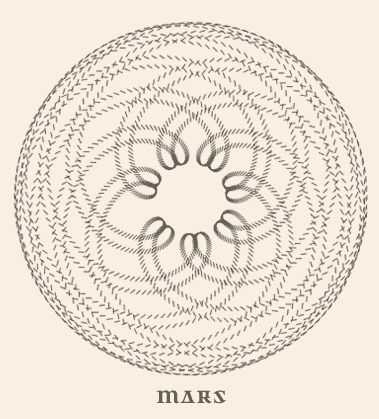
I recently ran across a diagram that showed the “orbit” of the planet Venus around the Earth. Sure, we all know that the planets go around the Sun, but for thousands of pre-Galileo years, the Earth was the center. It’s very simple to draw, explain, and show the orbit of the planets around the Sun, and we all understand the concept of heliocentricity without a problem. It’s simple, The Earth goes around the Sun, the planets go around the Sun, we’ve got it.
However, if you try to describe, or draw the orbit of the planets from a geocentric perspective, it can be quite difficult. There is a pattern, it does repeat, and it actually creates a nice design, but it is very complex to illustrate and explain.
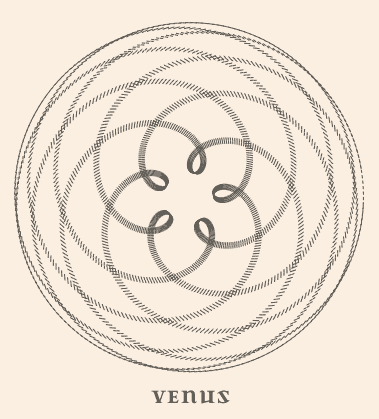
So it goes with design, sometimes you need to change your perspective in order to visualize the solution in its most simple form. Sometimes you need to find ways to help your users change their perspective so that they can see the problem from your perspective. Sometimes your users are already visualizing the problem from the simplest perspective, and you change it, or redesign it to work from your perspective.
As designers it’s our job to visualize things from different perspectives, hunting down the simplest, and most elegant solution, and bringing that to our users.
posted by
john
on Thursday, Aug 31, 2006
“If your words aren’t truthful, the finest optically letter-spaced typography won’t help. And if your images aren’t on point, making them dance in color in three dimensions won’t help…If you look after truth and goodness, beauty looks after herself.”
Edward Tufte
posted by
john
on Tuesday, Aug 29, 2006
Dan Saffer from Adaptive Path writes about what it means to be an Interaction Designer and what it takes to become one. So You Want to Be an Interaction Designer 2006 is a great read for understanding what we are trying to do here.
posted by
john
on Monday, Aug 28, 2006
In our jobs, working for the LDS Church, we work on projects that do not generate financial income. This is very different than the corporate world that I’m used to, but also a very good thing. The projects we work on do not generate income, but they do use financial resources of the Church, and the bar is set very high to use those resources in the most effective way possible. This environment requires an extra level of vigilance and “project soul searching” that may not happen (although it probably should) in the corporate world. In this quest for meaning, I’ve been bombarded with questions. The process of questioning doesn’t always get to the answer. In fact, if you’ve got all the answers, the chances are that you don’t really understand the problem. The purpose of questioning is to gain a better understanding of the problem, where your solution fits in, and what effect it will really have on your customers and end users.
- What am I doing?
- Why am I doing it?
- Who am I doing it for?
- Why do they need it?
- Is it really an issue for them, or is it for me?
- Is what I am doing useful?
- Is it necessary?
- Am I really hungry already?
- What is the Issue?
- Why is it an Issue?
- How important is the Issue?
- What would happen if I didn’t try to solve the issue?
- Are there other options for addressing the issue?
- Is there already a solution that addresses the issue?
- Has the existing solution been implemented?
- If so, why hasn’t that fixed the issue?
- What is this isn’t really the issue?
- Is there an issue bigger than the issue I think I’m trying to solve?
- Where am I going to go for lunch?
- Is there a smaller, more focused issue that I haven’t thought of that would be easier to solve?
- What is the proposed solution?
- Why is that a solution and not a new problem?
- What is the objective of that solution?
- Who is going to use that solution?
- Why are they going to use it?
- What is the solution going to change?
- How are you going to know that it will really change?
- How important is that solutions, really?
- Is that solution possible?
- Are you sure that it is not possible?
- How much money do I have for lunch?
- Do you have the resources (time, money) to implement the solution?
- Do you really want to implement the solution?
- Are there situations or circumstances where the solution won’t work like you expect it to?
- Are there other solutions that this new solution will replace?
- Are there new solutions that must be developed because of this solution?
- Is it lunch time yet?
Andy Rutledge makes some good points on this also in his article “Seek Understading, Not Answers”
posted by
john
on Wednesday, Aug 23, 2006